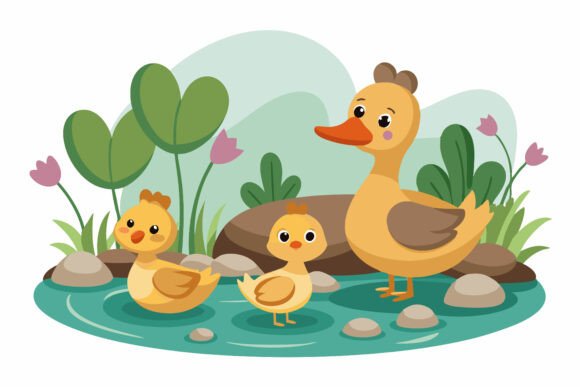
Duck and Ducklings on the Pond: What Makes This Vector Illustration Set a Smart Choice for Design Projects
Selecting the right illustration for a design project goes beyond simply finding a pleasant image. The file format, editability, visual consistency, and how well the asset fits into your workflow all matter—especially when you are comparing options or trying to avoid rework later. Duck and Ducklings on the Pond is an example of a resource designed with those practical needs in mind. It belongs to a collection of AI EPS illustrations curated to give users more flexibility than a typical stock graphic, while still delivering a complete, polished scene right out of the folder. For professionals and hobbyists alike, understanding where an asset like this sits among alternatives can save both time and creative energy.
What Sets This Illustration Apart from Common Stock Files
Unlike a flat raster image that locks you into a single resolution and color scheme, Duck and Ducklings on the Pond arrives as a pair of complementary formats: an editable AI EPS file and a high-resolution JPG. The vector version is the core of the package. It contains the illustration constructed as paths, shapes, and layers—meaning you can open it in Adobe Illustrator, Affinity Designer, CorelDRAW, or other compatible software on both Mac and Windows. From there, you can change colors, resize without degradation, repurpose individual elements, or even adapt the style slightly to match a brand palette. The companion JPG gives you an immediate, ready-to-use raster option for quick placement in presentations, mockups, or social media posts without ever needing to export from a design tool.
The file structure itself is another differentiator. Many free or low-cost vectors are poorly organized, with dozens of unnamed layers that make selecting and editing a single duckling far more tedious than it needs to be. Here, the layers are separated logically—adult duck, each duckling, water ripples, background reeds, and reflective details are all clearly labeled and grouped. This level of organization turns the file from a simple picture into a flexible design asset that can be deconstructed and reused across multiple layouts, from infographics to app icons.
Editable Vector vs. Raster-Only Graphics
When you download a JPG or PNG, you are essentially getting a snapshot. Any scaling up introduces blur, and changing colors requires careful selection and masking, often leading to disappointing results. Duck and Ducklings on the Pond bypasses those constraints by providing the original vector artwork. You can separate the duck from its background, adjust the water’s hue for a different setting, or even animate the file because each element is an independent object. For anybody creating print collateral, the difference is especially meaningful: you can output the illustration at billboard size without losing a single detail.
Well-Structured AI EPS vs. Typical Free Vectors
Free vector libraries can be treasure troves, but they frequently come with tradeoffs. Files may be cluttered, use stroke outlines that behave unpredictably when scaled, or rely on outdated color profiles. Some lack proper expansion of strokes and brushes, which means editing leads to distorted shapes. In contrast, this set emphasizes perfection in details and consistency. The line weights, curves, and shading are uniform across the scene, and because the file is neatly organized, even a designer new to a particular software can begin modifying it within minutes. That reliability is a practical advantage when deadlines are tight and you cannot afford to troubleshoot a messy file.
Cross-Platform Compatibility
Design teams often have a mix of Mac and Windows users. The AI EPS format was chosen intentionally for its wide support. You are not locked into a proprietary file type that only works in one environment. This cross-platform readiness means you can pass the file to colleagues, clients, or external agencies and trust that they will see the same high-quality result you do. For collaborative projects, that eliminates a common friction point.
Where Duck and Ducklings on the Pond Fits Best
Understanding when an asset is the ideal choice is just as important as recognizing its weaknesses. Consider the following use cases where this illustration tends to excel:
- Branded infographics and data visualization: The clean, consistent style of the ducks blends well into charts and diagrams. Since colors are fully editable, you can match them to corporate guidelines without clashing.
- Print materials like brochures, children’s books, or environmental signage: The vector source allows infinite scalability. The charming subject matter appeals to family-oriented audiences, educational contexts, or outdoor-themed campaigns.
- App and web symbols: Individual ducklings can be extracted, simplified, or recolored to serve as icons, buttons, or decorative elements in a user interface.
- Presentation graphics: Drop the ready-made JPG into a slide deck, or customize the vector artwork to tell a visual story that aligns with your narrative.
- Learning projects: Intermediate users who want to study how a professional vector illustration is constructed will find the layered AI EPS file an excellent educational reference.
In each scenario, the common thread is that you need more than a static picture—you need an adaptable graphic that can live across multiple deliverables while maintaining visual harmony.
Strengths That Go Beyond the Image
The most obvious benefit of Duck and Ducklings on the Pond is the charming scene itself: a mother duck gliding on calm water with ducklings following closely in her wake. Yet what matters in a professional context extends to the production values behind the file. Users frequently underestimate how much time a poorly built vector can waste. Here, the design team has invested in meticulous layer naming, grouping, and an overall structure that makes every element accessible. From a practical standpoint, this translates into faster edits and fewer frustrating surprises.
Another strength is the dual delivery of AI EPS and JPG. The JPG eliminates the step of exporting a preview, which can be a subtle time-saver during early concept stages or when sharing with stakeholders who do not have vector editing software. Having both formats in one package means you are not forced to choose between editability and immediate usability. You get both from the start.
Additionally, the illustration’s realism and attention to detail—rippled water reflections, subtle feather textures, and natural poses—set a standard that often surpasses generic stock clip art. The consistency extends across all elements, so if you combine the ducks with other graphics from the same collection, the visual tone stays cohesive. That kind of continuity is hard to achieve when mixing assets from many different sources.
Tradeoffs and Considerations
No design resource is universally perfect, and Duck and Ducklings on the Pond comes with limitations worth acknowledging. First, it is a premium resource, not a free download. For someone testing a concept or working with a very limited budget, the cost might outweigh the benefits—especially if the illustration will only be used once at a small size. Free alternatives exist, though they rarely offer the same degree of editability and polish.
Second, the subject matter is specific. If your project demands a range of farm animals, forest creatures, or a variety of waterfowl in different styles, this one set will not be a one-stop solution. You may need to invest in multiple files or look for a more comprehensive bundle. The value proposition here is depth, not breadth: a single scene executed exceptionally well rather than a large pack of average graphics.
A third point involves software requirements. While the JPG can be used anywhere, unlocking the full potential of the AI EPS file requires some familiarity with vector editing tools. Beginners might find the learning curve steep, even with a tidy layer structure. If you are not ready to invest time in learning how to isolate, recolor, or repurpose vector objects, you may only scratch the surface of what the asset can do. In such cases, a simpler, less customizable, raster-only graphic might suit immediate needs more comfortably.
When an Alternative Might Serve You Better
Not every design situation calls for a premium, editable illustration. If you are producing quick social media posts, need an image for a one-time event, or require a highly specific art style—say, watercolor or hand-drawn ink—Duck and Ducklings on the Pond may not align with your vision. Similarly, if your workflow is entirely within tools that handle only raster formats and you never adjust colors or layouts, the vector advantages go unused. In those circumstances, a more straightforward stock photo or a free vector from a reputable library could be a more sensible choice. You might also consider commissioning a custom illustrator if the brief demands something entirely unique that a pre-made scene cannot capture.
For large-scale branding projects that need a consistent illustration system across dozens of assets, one standalone scene will not be sufficient. You would need a whole series built in the same style, either by purchasing the entire collection it belongs to or by working with a designer to extend the visual language. Recognizing these boundaries helps you invest your budget and effort where they will have the most impact.
Making an Informed Decision
Choosing an illustration like Duck and Ducklings on the Pond involves weighing convenience against control, and cost against potential time savings. The package is designed for users who want more than a passive image: they want a building block they can mold to fit various layouts, color schemes, and sizes. The neat file organization, dual format offering, cross-platform compatibility, and scrupulous attention to detail all point toward a resource built for iterative, professional use. At the same time, it is not a universal tool. Projects that demand zero editing, extremely rapid turnaround with no learning investment, or a broader selection of imagery may be better served by alternative routes.
As with any design asset, the starting point is clarifying what you actually need. If you can envision recolorable duck graphics spread across a website, printed poster, and mobile app—then a vector illustration with these qualities can do more than decorate; it can become part of a consistent visual system. The value lies not just in the drawing itself, but in the thoughtful preparation of the file that makes your work smoother and your output more polished. That is the kind of practical consideration that separates a carefully produced illustration set from a quick download.