Why Automotive E-commerce Solid Icons Are Shaping the Next Wave of Visual Communication
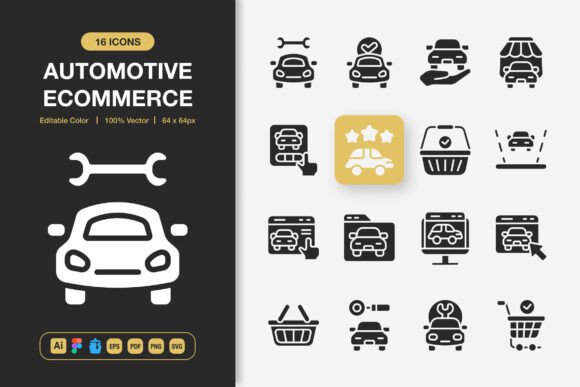
Visual language in digital products has never been static, but few shifts have been as telling as the steady move toward clarity, restraint, and functional beauty. The Automotive E-commerce Solid Icons set captures this shift exactly—offering a collection of high-quality, solid-style icons designed to bring immediate coherence to websites, mobile apps, social media visuals, and printed collateral. In an environment where every pixel counts and user attention splinters within seconds, these icons do something rare: they communicate instantly without demanding explanation.
What makes this set particularly interesting is not simply the automotive theme, but how it bridges niche-specific imagery with universally demanded design attributes—clean geometry, consistent stroke weights, and thoughtful minimalism. Designers, product managers, and entrepreneurs are recognizing that iconography is no longer a decorative afterthought; it is a functional asset that determines how quickly users navigate an interface, understand a feature, or trust a checkout flow. The Automotive E-commerce Solid Icons set delivers on that promise, providing over 100 customizable icons that integrate effortlessly across platforms and tools.
The Shift Toward Minimalist, Context-Aware Icon Design
During the last decade, we watched skeuomorphism give way to flat design, which in turn matured into a more balanced, refined aesthetic where solid icons hold a distinct place. Solid icons—filled shapes with consistent visual weight—work especially well in e-commerce environments where buttons, navigation rails, and informational badges must stand out against busy product imagery. Automotive e-commerce, in particular, operates at a crossroads of trust, precision, and lifestyle branding. Whether a user is browsing electric vehicle accessories, booking a service appointment, or comparing tire specifications, the supporting visuals need to feel both authoritative and frictionless.
This is where the Automotive E-commerce Solid Icons collection becomes more than a design resource—it becomes a strategic tool. By offering a complete visual vocabulary around automotive retail, maintenance, parts, and mobility, it eliminates the messy process of mixing and matching disjointed icon libraries. Designers can maintain a unified interface language from the landing page down to the order confirmation screen.
Practical Examples Across Digital and Print Workflows
Consider a modern automotive marketplace app. The home screen might use a solid steering wheel icon to denote “Drive,” a spanner for “Services,” a charging plug for “EV Solutions,” and a shopping bag for “Store.” When each of those icons shares the same grid, line thickness, and optical balance, the interface immediately feels intentional. With the Automotive E-commerce Solid Icons set, that consistency is built in from the start—no manual adjustments or visual compromises.
Flyers and posters for dealership promotions gain similar benefits. A high-quality solid icon representing a car key, a calendar, or a percent badge can anchor promotional sections, guide the reader’s eye, and reinforce branding without overwhelming the message. Because the set includes PNG transparency, SVG, PDF, and EPS Version 10 files, the same icon can move seamlessly from screen to print without a loss in fidelity. Social media managers, infographic designers, and ebook authors all benefit from the easy drag-and-drop compatibility with Figma, Adobe Illustrator, and Iconjar.
Why Professionals Are Paying Attention to Dedicated Icon Sets
There is a growing understanding that generic icon packs often cost more in the long run—in time spent editing, resizing, or replacing icons that feel slightly off-brand. The appeal of the Automotive E-commerce Solid Icons set lies in its focused curation. When an icon pack is purpose-built for an industry, the metaphors are sharper, the symbols more intuitive, and the narrative alignment stronger.
Marketers in the automotive aftermarket space, for instance, need to represent complex concepts like warranty, financing, trade-in, and vehicle inspection with absolute clarity. A generic shopping cart icon might work for retail, but a distinct automotive e-commerce context benefits from icons that actually look like automotive tools, dashboards, or service bays. This semantic precision reduces cognitive load and subtly builds user confidence—a crucial factor when average order values in automotive e-commerce can be significantly higher than in general retail.
Changing Needs in a Mobile-First, Speed-Driven Ecosystem
Mobile app interfaces and progressive web apps now dominate automotive shopping and service booking. According to multiple industry reports, over 70% of automotive research starts on a mobile device. In that environment, solid icons perform exceptionally well because they remain legible at small sizes, load quickly as SVGs, and do not rely on fine hairlines that vanish on lower-resolution screens. The 100 customizable icons in this set have been crafted with exactly these constraints in mind—recognizable at a glance, scalable without degradation, and ready to integrate into design systems with minimal friction.
Furthermore, design teams increasingly collaborate across tools. Someone might set up a component library in Figma while a colleague refines assets in Adobe Illustrator. A developer then pulls SVGs directly into the codebase. The fact that this icon collection provides Figma File, Adobe Illustrator, Iconjar File, SVG, and PDF formats reflects an awareness of real, distributed workflows. Documentation is included via a Readme.txt, which may seem modest but in practice saves considerable onboarding time for teams juggling multiple asset packs.
Connecting Automotive Icons to Larger Business and Creative Trends
Looking outward, the automotive industry is undergoing its most significant transformation in a century. Electrification, autonomous features, connected services, and changing ownership models—from subscription to peer-to-peer sharing—are reshaping how companies talk to customers. Visual communication must evolve in parallel. A set of Automotive E-commerce Solid Icons designed with modern sensibilities helps businesses signal that they understand today’s consumer: digitally native, design-aware, and intolerant of cluttered, outdated interfaces.
There is also a quiet but important business case here. Startups and small e-commerce operations often cannot afford custom icon design from scratch. Yet they compete with major platforms that invest heavily in user experience. A comprehensive, high-quality icon set levels the playing field, giving smaller players access to the same polished visual language that larger companies enjoy. The solid style offered here fits directly into the contemporary design canon—bold, approachable, and technically robust.
How Minimalist Icon Design Strengthens Brand Identity
Brands spend enormous effort on typography, color palettes, and photography style. Icons, however, are sometimes an afterthought—patched in from disparate free sources. The result is a subtle but corrosive visual inconsistency that erodes trust. When an automotive e-commerce site consistently uses the Automotive E-commerce Solid Icons set across product categories, support pages, and promotional banners, the accumulated effect is professionalism. Users may not consciously notice the icons, but they will register the ease of navigation, the clarity of meaning, and the cohesive feeling of the experience.
Minimalist icon design, when executed well, also ages gracefully. Trends in gradients and 3D illustrations come and go, but solid, well-proportioned icons remain relevant because their core value is legibility, not decoration. For long-term projects—corporate websites, SaaS platforms, or multi-year brand campaigns—investing in a clean, dedicated icon set pays dividends in reduced redesign cycles.
Files, Formats, and the Practicalities of Integration
The landscape of design tools has expanded dramatically, and format compatibility is no longer a luxury—it is a basic requirement. The inclusion of Source File Adobe Illustrator, EPS Version 10, and Iconjar File alongside more web-centric formats like SVG and PNG demonstrates an understanding of both legacy and modern pipelines. Print designers can confidently pull the PDF files into InDesign layouts for brochures or banners. UX designers can drag icons directly from Iconjar into Sketch or Figma. Developers can optimize SVGs for web performance without converting from a single, bloated master file.
The mention of PNG Transparency is significant for those working in less technical environments—social media managers creating Instagram stories, educators assembling presentations, or small business owners building simple flyers. They can drop a transparent PNG icon onto any background color and it will blend cleanly without that jarring white-box outline that plagues so many downloaded assets.
Why 100 Customizable Icons Strike the Right Balance
There is wisdom in offering a curated collection rather than thousands of icons with uneven quality. The 100 customizable identifier signals restraint and purpose. For automotive e-commerce, covering core concepts—vehicles, parts, tools, finance, shipping, support, and user actions—creates a complete system without overwhelming the designer. Customizability further means stroke widths, colors, and sizes can be adjusted while preserving the underlying geometry. This flexibility ensures the icon set can adapt to different brand guidelines rather than forcing a brand to accept a predetermined look.
Moreover, in design systems where consistency is paramount, having a fixed number of well-maintained icons simplifies audits and ensures that no icon is used that hasn’t been through the same quality assurance process. Teams can confidently assign icons to components, knowing the entire set meets the same high quality standard.
Tying Everything Together: From Single Project to Design Ecosystem
The Automotive E-commerce Solid Icons set is not just a download; it is a foundational asset that supports a wide spectrum of creative outputs—websites, mobile apps, books, social media, infographics, flyers, print, banners, posters, and beyond. In a world where visual consistency increasingly separates thriving brands from forgettable ones, having a cohesive, immediately usable icon library directly addresses a persistent pain point. Designers save hours of hunting, editing, and aligning mismatched assets. Business owners gain confidence that their digital storefront looks polished and intentional. Developers implement faster because the assets are provided in the right formats from the start.
As the automotive sector accelerates its digital transformation, the demand for precise, elegant, and robust visual tools will only intensify. The quiet power of a well-drawn solid icon—immediately understood, universally scalable—makes it one of the smartest investments a project can make. Whether you are launching a new online parts store, refreshing a dealership app, or crafting a marketing campaign around mobility services, the Automotive E-commerce Solid Icons set delivers the clarity and professionalism that modern audiences expect.
In the end, icons are a small element with outsized impact. They shape perception before a single line of copy is read. They guide, reassure, and direct. By choosing a set built with quality, compatibility, and real-world workflows in mind, creators and entrepreneurs equip themselves with a visual advantage that works across every touchpoint—silently, effectively, and beautifully.