Evaluating Water Treatment Icons for Modern Design Projects
Selecting the right icon set can shape how efficiently a design project progresses and how clearly an audience understands complex environmental topics. Water Treatment Icons offer a curated collection of visual symbols focused on purification, filtration, recycling, and water management systems. These icons come in multiple file formats and styles, giving designers flexibility across digital and print work. This article examines the practical value, strengths, limitations, and ideal use cases of water treatment iconography so you can decide whether this resource aligns with your next creative initiative.
Understanding the Scope of Water Treatment Icons
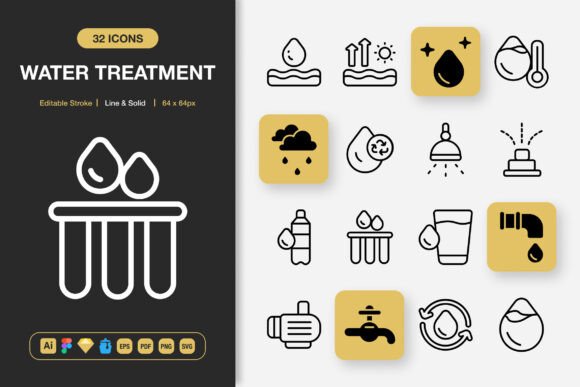
At its core, Water Treatment Icons refer to a pack of high-quality vector and raster graphics that visually represent stages of water processing. Common symbols include filtration units, pipes, droplets, treatment tanks, recycling arrows, purification membranes, and chemical dosing indicators. What sets a comprehensive set apart is consistency in line weight, corner radius, and optical balance — details that improve readability across different screen sizes and print resolutions.
The collection typically includes line style and solid style variations for each symbol. Line icons work well for minimal user interfaces and subtle infographic accents, while solid icons provide stronger visual weight for buttons, app navigation, and bold presentation slides. Having both options in one pack reduces the need to source matching icons from multiple libraries.
File Format Versatility and Cross-Platform Compatibility
A practical strength of this type of icon set lies in its delivery across numerous industry-standard formats. The included files often span Adobe Illustrator source documents, Figma components, Iconjar packages, Sketch libraries, EPS version 10, PDF, and SVG files. Raster needs are met with PNG exports at multiple dimensions — typically 32px, 48px, 64px, 96px, 128px, 256px, and 512px. This structured sizing saves time when importing assets into presentation decks, mobile prototypes, or website builders.
The inclusion of a readme.txt file may seem minor, but it often contains licensing details, usage guidelines, and tips for customizing strokes or colors. For teams onboarding new designers, such documentation helps maintain visual consistency across projects without lengthy internal training.
Reasons Designers and Content Creators Seek Water Treatment Icons
Interest in this icon category often stems from specific project demands rather than general browsing. Environmental agencies, engineering consultancies, educational publishers, and sustainability brands frequently need to communicate water-related processes clearly. Generic icon libraries rarely cover niche symbols like backwash filters, sludge thickeners, or ion exchange columns with the technical accuracy an informed audience expects.
Another motivation is the need for editable stroke capabilities. Designers who customize icon thickness to match brand guidelines can adjust stroke weights without distorting proportions. Since the source files are fully modifiable, you can recolor elements, remove details, or combine symbols to create entirely new meanings without starting from scratch.
Minimalist Design That Adapts Across Media
Modern visual communication increasingly favors clean, distraction-free iconography. Water Treatment Icons built with a minimalist approach suit a wide range of surfaces — websites, mobile apps, books, social media posts, infographics, flyers, print materials, banners, and posters. A unified visual language helps audiences connect a brand's digital presence with its printed reports. When the same icon style appears in an annual sustainability brochure and an interactive dashboard, the identity feels intentional and professional.
Benefits Worth Weighing Before Purchase
Beyond format support and style variety, several concrete advantages emerge when integrating these icons into a workflow.
- Time efficiency: Pre-built, high-quality assets eliminate the hours needed to draw process symbols from scratch, especially when deadlines are tight.
- Drag-and-drop readiness: Many formats, including Figma and Iconjar, support instant placement, reducing friction during wireframing or layout composition.
- Resolution independence: Vector formats scale infinitely, while pre-rendered PNGs at multiple sizes simplify use in slide decks and social media graphics that require exact pixel dimensions.
- 100% customizability: Because source files are provided, icons can be reshaped, recolored, or animated to match evolving brand systems without purchasing additional licenses.
- Stylistic coherence: A single icon set guarantees consistent visual weight, corner rounding, and spacing — details that become visibly inconsistent when mixing icons from different creators.
Trade-Offs and Considerations When Using a Pre-Made Set
While pre-designed water treatment icon sets solve many problems, they require honest assessment against project constraints. One common trade-off involves over-specificity. A pack may include dozens of wastewater symbols but lack the exact membrane bioreactor configuration your technical diagram needs. In such cases, you might still need to commission a custom icon or modify one of the existing symbols significantly, which demands intermediate vector editing skills.
Another consideration is visual distinctiveness. Because multiple organizations may purchase and use the same icon pack, there is a possibility of encountering identical symbols in competing reports or websites. While this risk is generally low for niche industrial topics, brands with high visibility may want to customize icons at a deeper level — adjusting not just color but also core geometry — to maintain uniqueness.
The learning curve for source file manipulation should also be weighed. If your team lacks proficiency in Adobe Illustrator, Figma, or Sketch, the promise of full editability may remain unrealized. In such environments, it may be wiser to invest in basic vector training alongside the icon purchase, or to delegate customization to a designer who regularly works with these tools.
Situations Where Water Treatment Icons Excel
Some projects align almost perfectly with what a well-constructed water treatment icon set delivers. Consider the following scenarios where these resources commonly shine.
Engineering and environmental consulting firms producing client-facing reports often need to illustrate treatment trains, process flow diagrams, and water cycle stages without overtaxing their graphic design staff. Icons that are both technically recognizable and aesthetically restrained strike the right tone for government submissions and corporate proposals.
Educational publishers and e-learning developers creating content about water conservation, pollution control, or sanitation infrastructure benefit from clear, reproducible symbols that students can quickly interpret. The availability of both line and solid versions allows for differentiated emphasis — line icons for background context, solid icons for key interactive elements.
Mobile app and web platform designers addressing water usage tracking, irrigation planning, or environmental monitoring often embed icons in dashboards and navigation menus. Here, drag-and-drop functionality and pixel-perfect PNG exports directly speed up iterative prototyping and user testing cycles.
Marketing teams promoting sustainability initiatives through infographics, banners, posters, and social media campaigns value icon sets that maintain visual quality across both large-format print and small-screen mobile feeds. A single cohesive set reduces the need to search for matching visual assets across different campaigns.
When Alternative Approaches May Be Worth Considering
There are circumstances where purchasing a dedicated water treatment icon set might not be the most economical or practical path.
If your project only requires a handful of generic water symbols — such as a single water drop, a faucet, and a recycling emblem — broader icon libraries that come bundled with design tools may already contain acceptable options. Many subscription-based icon platforms allow per-icon export in multiple styles without committing to a full niche pack.
Projects with highly specialized technical requirements may need custom illustration from the start. An organization developing proprietary filtration equipment with unique geometries might find that no existing icon adequately represents its technology. In this case, hiring a technical illustrator or investing in in-house design time could produce more authentic results that align precisely with patent diagrams or product schematics.
Extremely tight budgets may also push teams toward open-source icon repositories. While the selection of water treatment-specific symbols in free libraries is typically limited, creative reuse and minor editing can sometimes bridge the gap for internal presentations or preliminary mockups. Just be mindful of licensing restrictions if the work will be publicly distributed or embedded in commercial products.
Practical Insights for Decision-Making
Before committing to a water treatment icon asset, it helps to audit your current and near-future projects. List the deliverables that require water-related iconography, note the preferred styles, and check which software your team uses daily. If your workflow revolves around Figma for prototyping and Adobe Illustrator for final asset creation, verify that the pack's Figma and AI source files are well-structured — with organized layers, properly named components, and clean artboards.
Examine sample previews carefully, paying attention to stroke consistency, padding, and alignment to pixel grids. Icons that appear sharp at 24px but blur or lose detail at smaller sizes may cause problems in mobile interfaces. Similarly, check how solid icons hold up when reversed out of dark backgrounds or placed on photographic surfaces. Good sets maintain legibility across diverse contexts.
Consider the long-term value of the included file formats. If your organization transitions between design tools — moving from Sketch to Figma, for instance — having multiple native files prevents future conversion headaches. The presence of SVG and EPS versions ensures backward compatibility with older software or print production pipelines that rely on legacy formats.
Aligning Water Treatment Icons With Your Design Goals
Ultimately, the decision to use a dedicated water treatment icon set comes down to balancing specificity, quality, and efficiency. When your communication goals demand clear, professional visuals that accurately represent water processes — and you want to avoid the time investment of building from scratch — a well-rounded icon pack offers strong practical value. The combination of editable stroke, line and solid styles, drag-and-drop ease, and extensive format support makes it a pragmatic tool for many creative disciplines.
Take stock of your project requirements, the technical skill level of your team, and the uniqueness your brand demands. If those factors point toward a ready-made, high-quality resource that covers a wide range of water treatment symbols, integrating this type of icon collection can meaningfully elevate the clarity and consistency of your visual storytelling across websites, mobile interfaces, print materials, and beyond.