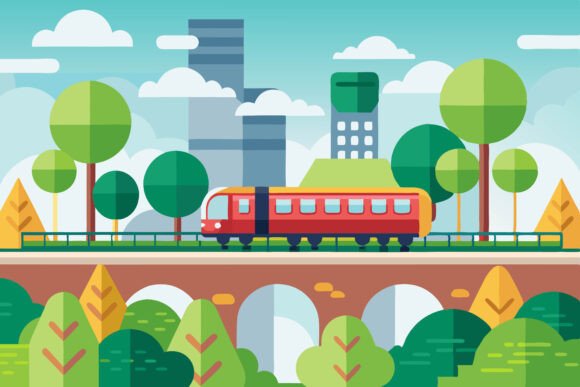
Railway Train Vector Art: AI EPS Collections Explained
Finding the right illustration can feel like searching for a specific carriage in a sprawling rail yard. You know the look you want, but the technical side matters just as much as the visual. Railway train illustrations packaged in professional AI and EPS formats offer something different from a simple downloaded image. They arrive as structured, editable graphics that adapt to your project rather than forcing you to work around limitations. Understanding what these collections contain helps you decide whether they fit your next design task, presentation, or product.
Not every train graphic is built the same way. Some are flattened pixels that crumble when you scale them. Others are vectors with real architecture behind the scenes—organized layers, consistent line weights, and thoughtfully grouped elements that make editing intuitive instead of frustrating. The railway train sets built around AI and EPS files fall into this second category, and the difference becomes apparent the moment you open the file and see how everything clicks together.
What Sets AI and EPS Train Illustrations Apart from Standard Graphics
When a railway train illustration arrives as an AI (Adobe Illustrator) or EPS (Encapsulated PostScript) file, you receive more than a picture. You receive a construction kit. Every wheel, window, rail line, and locomotive detail exists as a separate editable element. This matters differently depending on who you are and what you need to accomplish.
For the small business owner designing a logo, the ability to pull a single train icon from a larger scene and recolor it to match brand guidelines saves hours of work. For the blogger creating a transportation-themed infographic, having access to multiple train types within one unified visual style keeps the final graphic cohesive. The marketer preparing social media posts benefits from knowing the JPG preview files can go straight into Canva or a similar tool without conversion, while the full vector remains available when the printed brochure demands higher resolution.
The format support also spans operating systems. Someone working on a Windows machine and a collaborator using a Mac can both open and edit the files without compatibility headaches. This cross-platform reliability removes friction from team projects and freelance handoffs.
Inside a Well-Organized Vector File
Opening a neatly structured AI EPS illustration feels different from opening a chaotic one. Elements sit on clearly named layers. You can toggle a background off, isolate a specific train car, or adjust the thickness of track details without hunting through hundreds of unnamed paths. This organizational structure matters for speed and sanity, especially when deadlines tighten.
Graphic designers who regularly prepare files for print notice the consistency immediately. Line weights stay uniform across the set. Curves meet cleanly without awkward gaps. Shadows and highlights follow the same light source from one illustration to the next. When you place multiple train graphics on the same page—perhaps for a catalog, a website, or an educational poster—this consistency prevents the jarring mismatch that occurs when cobbling together images from different sources.
Beginners benefit from this structure in a different way. Opening a professionally organized file teaches visual hierarchy by example. You can see how the illustrator grouped components, applied colors, and built complexity from simpler shapes. It functions as a learning resource even while serving as a production asset.
Versatility Across Print, Web, and Interactive Projects
Railway train illustrations in these formats slide naturally between mediums. The same graphic that prints crisply on a flyer also renders cleanly as an app icon, a website hero element, a presentation slide accent, or a printed t-shirt design. Vector files scale without degradation, so a train icon shrunk to favicon size remains recognizable, and the same graphic blown up to billboard proportions stays sharp.
Educators building classroom materials find this adaptability practical. A single train illustration can appear in a printed worksheet, a projected slideshow, and an online quiz without needing separate versions. Publishers laying out a children's book or a railway history magazine appreciate that the illustrations remain crisp at 300 DPI print specifications, with no pixelation or softness creeping in at the edges.
App and web developers working on transportation or travel platforms use these icons for interface elements. The ability to quickly recolor a train icon to indicate active versus inactive states or to match a dark mode interface saves development time. Infographic designers lean heavily on this flexibility too, pulling parts of a larger illustration—maybe just the engine, maybe just a single carriage—to use as standalone data markers or category icons.
Customization Without the Learning Cliff
Editing a vector train graphic should not require a design degree. The best AI EPS collections reduce complexity wherever possible. Colors change with a few clicks. The shape of a window or the length of a carriage adjusts by dragging anchor points or sliders. You can remove the background entirely for transparent PNG exports or swap the sky gradient behind the train for something that fits your layout.
Hobbyists designing model railway promotional flyers or event posters discover that minor tweaks—adding a logo to the side of a locomotive or recoloring passenger cars to match a historical era—happen in minutes rather than hours. Freelancers charging by the project find this efficiency translates directly into better margins. The less time spent wrestling with a file, the more time available for creative decisions that elevate the final product.
This editability also supports brand consistency. A marketing team can standardize their color palette across every train graphic in a campaign, ensuring the illustrations feel native to the brand rather than like borrowed assets. A blogger with a specific visual theme can recolor the entire set to match their site palette, creating a custom feel from a commercially available collection.
Matching the Illustration Set to Your Specific Needs
Not every railway train illustration set suits every project. Someone designing a vintage railway poster needs different stylistic qualities than someone building a modern transit app. The practical way to evaluate a collection involves looking past the preview thumbnails and considering the structural elements: how the file is built, how easily it adapts, and how consistently the quality holds across the full set.
If you regularly produce print materials, confirm that the AI and EPS files are built with CMYK support in mind. If web work dominates your day, check that the JPG previews are high-resolution enough to use directly in content management systems. If you expect to animate elements later, confirm that the layered structure groups logically so you can export individual assets without laborious isolation work.
Creative professionals with established workflows typically appreciate the time saved by starting with a clean, organized file rather than redrawing or cleaning up a messy download. Beginners and those newer to vector editing find that a well-documented, logically structured file flattens the learning curve and produces better results faster. For the project that simply needs a reliable, attractive railway train graphic without fuss, the combination of AI, EPS, and JPG formats in one download covers nearly every possible use case.
Evaluating a collection based on detail consistency, organizational quality, and format flexibility leads to better decisions than judging on visual appeal alone. The train illustration that looks stunning in a preview can become a problem if its internal structure fights every attempt to modify it. The reverse holds too: a modest-looking graphic with impeccable construction might become your most-used asset because it bends to every creative need you throw at it.
Practical Scenarios Where Railway Illustrations Shine
A travel blogger creating a railway journey guide needs images that stay clear when readers zoom in on mobile devices. A children's book illustrator adapting a locomotive scene for a print spread requires control over individual elements so the train can interact with other illustrated components. A startup founder prototyping a train-booking app interface needs icons that look polished at tiny sizes and remain legible against varied backgrounds. An educator preparing a transportation history unit wants train types from different eras rendered in a style consistent enough to compare side by side.
Each of these scenarios demands something slightly different from the illustrations, yet a well-constructed AI EPS set can serve them all. The common thread is this: flexibility, editability, and consistent quality reduce the friction between having an idea and executing it.
For those who create regularly—whether professionally or for personal projects—building a library of reliable, editable vector assets pays dividends over time. A railway train illustration set that includes multiple formats, logical organization, and careful attention to detail becomes a reusable resource rather than a one-off purchase. The next time a project calls for transportation imagery, the file sits ready, editable, and adaptable to whatever new context arises.